Unveiling the Impact of Dehydration on Athletic Performance
Welcome to our research project, "How does dehydration negatively affect athletic performances?". This page dives deep into the critical role of hydration in athletic success. Many athletes underestimate or overlook the significant impact of dehydration. Here, we explore the profound connection between water intake and performance. Join us as we uncover the answers to key questions and shed light on this vital aspect of athletic training and competition.
The Core Questions Driving Our Research
Our research is centered around understanding the specific ways dehydration impacts athletic performance. We aim to provide insights that athletes and coaches can use to optimize hydration strategies and improve results. The following questions guide our exploration:
- How does dehydration affect an athlete's ability to make split second decisions during a game or competition?
- To what extent does low to moderate dehydration affect sprint speed vs. long distance endurance in athletes during games or training?
- How consistently poor hydration during the week decreases the ability for athletes to maintain athlete performance throughout the entirety of a game?

How does dehydration affect an athlete’s ability to make split second decisions during a game or competition?
Dehydration has a serious negative effect on athletic performance, especially when it comes to an athlete’s ability to think quickly and react during games or competitions.
Research shows that even mild dehydration—around a 2% loss of body weight from fluids—can significantly reduce physical and mental performance. When the body loses water, blood volume decreases, meaning less oxygen and nutrients are delivered to both the muscles and the brain. This forces the heart to work harder and causes athletes to feel tired sooner, which directly affects reaction time and decision-making during high-pressure moments in a game.

One major reason dehydration affects split-second decisions is because the brain relies heavily on water to function properly. The brain is made up of approximately 75–85% water, and even small fluid losses can reduce focus, short-term memory, and information processing speed. When an athlete is dehydrated, neural communication slows down, making it harder to quickly read the game, anticipate opponents’ movements, or react at the right moment. According to Lone Star Neurology, dehydration slows reaction time and disrupts executive functions like planning and decision-making, which are essential in sports that require constant awareness and fast responses.
Dehydration also increases fatigue and raises core body temperature, further hurting performance as the game goes on. When the body cannot cool itself effectively through sweating, stress hormones are released and mental fatigue increases, leading to more mistakes and poor judgment. Athletes may hesitate, misjudge plays, or react slower late in competition when hydration levels are low. Spooner Physical Therapy explains that dehydration leads to slower reaction times, dizziness, and reduced concentration, all of which make it difficult to perform consistently throughout a game.


Severe dehydration causes even greater performance declines. Studies show that dehydration of about 2.5% body weight can reduce high-intensity sprint performance by nearly 45%, while a 5% fluid loss can reduce overall work capacity by about 30%. Youth athletes are especially at risk because they lose fluids quickly and often do not feel thirsty until dehydration has already started. When athletes enter games already dehydrated from poor hydration habits during the week, both their physical strength and mental sharpness are compromised before competition even begins.
Overall, dehydration does not just make athletes feel tired—it slows their thinking, weakens focus, and reduces their ability to make fast, accurate decisions. Proper hydration is one of the simplest yet most important factors in maintaining peak athletic performance and mental sharpness throughout an entire game.

How Low to Moderate Dehydration Affects Sprint Speed vs. Long-Distance Endurance
Low to moderate dehydration has a measurable negative effect on athletic performance, but its impact differs between sprint speed and long-distance endurance. Research shows that even small fluid losses can impair both types of performance, with endurance being affected more consistently and earlier during activity.
Dehydration begins to impair performance when an athlete loses as little as 1–2% of body weight through sweat. Just 2% of body weight can reduce performance, while fluid losses greater than 5% may decrease total work capacity by up to 30%. These declines occur because dehydration reduces blood volume, thickens the blood, and forces the heart to work harder to deliver oxygen to working muscles.
In addition, dehydration reduces sweat rate and skin blood flow, making it harder for the body to cool itself. This causes a faster rise in core body temperature, leading to earlier fatigue and increased strain during both training and competition.
Effects on Sprint Speed
Sprint performance relies heavily on short bursts of high-intensity, anaerobic power. While a single sprint may appear less affected than endurance exercise, research shows dehydration can still significantly reduce high-intensity capacity. High-intensity exercise capacity can be reduced by up to 45% with dehydration corresponding to approximately 2.5% body weight loss.
Dehydration limits sprint performance by:
-
Reducing blood flow and oxygen delivery needed for repeated explosive efforts
-
Increasing fatigue during repeated sprints
-
Raising the risk of muscle cramps, dizziness, and reduced coordination
As a result, sprint athletes may struggle to maintain speed during games or training sessions that require multiple high-intensity efforts rather than just one short burst.
Effects on Long-Distance Endurance
Long-distance endurance is more severely and consistently affected by low to moderate dehydration. Endurance exercise depends on the aerobic energy system, which requires continuous oxygen delivery to working muscles. Even mild dehydration reduces blood volume, which lowers maximal aerobic capacity (VO₂ max) and forces the heart to work harder to circulate blood.
Losing as little as 2% of body weight through sweat causes a drastic drop in blood volume, reducing oxygen and nutrient delivery to muscles. This leads to:
-
Faster onset of fatigue
-
Slower pace and reduced ability to sustain effort
-
Increased heart rate and perceived exertion
-
Greater risk of heat-related illness
Because endurance athletes rely on efficient thermoregulation and oxygen delivery, dehydration causes performance to decline earlier and more noticeably than in sprint activities.
Why Endurance Suffers More Than Sprinting
The key difference lies in energy systems:
-
Endurance activities rely on aerobic metabolism, which is highly sensitive to reductions in blood volume, oxygen delivery, and temperature regulation.
-
Sprint activities rely more on anaerobic power, which can be maintained briefly but declines with dehydration during repeated efforts as fatigue accumulates.
While both are negatively affected, dehydration directly limits aerobic energy production, making endurance performance more vulnerable.
How Consistently Poor Hydration During the Week Affects Game-Long Performance
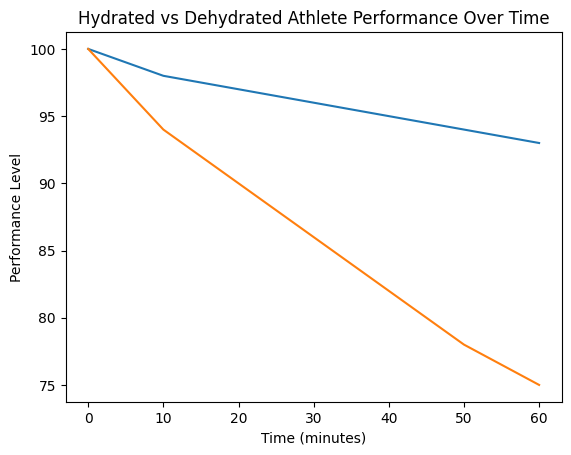
Consistently poor hydration throughout the week can significantly reduce an athlete’s ability to maintain performance for the entirety of a game. Hydration is not just important on game day; it plays a critical role in how well the body and brain function during daily practices that prepare athletes for competition. Water makes up approximately 55–60% of total body weight, with muscle tissue containing about 70% water, meaning even small fluid deficits can negatively affect muscle function, strength, and coordination.
When athletes fail to replace fluids and electrolytes lost during practices, they may begin each new training session already dehydrated. Over the course of the week, this leads to cumulative fatigue, reduced blood volume, and increased strain on the heart. As blood volume drops, less oxygen and nutrients are delivered to working muscles, causing athletes to tire faster and struggle to maintain intensity as a game progresses. Dehydration also impairs thermoregulation by reducing sweat rate and skin blood flow, making it harder for the body to cool itself and increasing the risk of overheating during competition.

Consistent dehydration also negatively affects cognitive performance, which is essential for decision-making, reaction time, and focus during games. Research has found hypohydration greater than 2% body mass loss was consistently associated with impaired cognition, increased fatigue, mood disturbances, and higher perceived exertion. These mental effects can reduce an athlete’s ability to stay focused, react quickly, and perform under pressure, especially late in games when fatigue is already high.
Muscle health and injury risk are also impacted by poor hydration habits. Dehydration and electrolyte loss increase the likelihood of muscle cramps, strains, and reduced muscle elasticity. Dehydration combined with muscle fatigue and tightness, makes athletes more prone to cramping, which can force them out of a game at critical moments. Proper hydration, combined with stretching and gradual training progression, helps keep muscles supple and reduces time lost due to preventable injuries.

Long-term hydration habits also affect overall energy, mood, and recovery. Even mild dehydration (1–2% body weight loss) can impair attention, short-term memory, and mood, all of which are essential for maintaining mental stamina throughout an entire game. If athletes consistently train in a dehydrated state during the week, they are more likely to feel tired earlier, recover more slowly, and experience a sharper decline in performance as the game continues.
Losing just 2% of body weight through sweat can reduce endurance, strength, reaction time, and recovery. Athletes who rely only on thirst cues or fail to replace electrolytes during long or intense training weeks often start games already under-hydrated, putting them at a disadvantage before competition even begins. This makes it more difficult to sustain performance, especially in hot conditions or during high-intensity play late in games.

Conclusion
Consistently poor hydration during the week compounds over time, leaving athletes physically and mentally underprepared for game day. Even mild dehydration can impair endurance, strength, reaction time, focus, and muscle function. Athletes who fail to hydrate properly throughout the week are more likely to fatigue sooner, make more mistakes, experience cramps or injury, and show a noticeable drop in performance by the end of a game. Maintaining proper hydration habits before, during, and after training is essential for sustaining peak performance from start to finish.
Recap
We pride ourselves on our adaptability and commitment to excellence in every aspect of our service. Explore what we have to offer and how we can contribute to your success.
Not drinking enough water during the week can hurt an athlete’s performance during a game. Athletes who do not replace fluids and electrolytes during practice may start games already dehydrated, which puts their body and brain at a disadvantage. Even small amounts of dehydration can lower strength, endurance, focus, and reaction time.
Losing just 1–2% of body weight from sweating can already reduce performance. Losing more fluids makes things worse. When athletes are dehydrated, they get tired faster and have a harder time keeping up as the game goes on.
Dehydration affects the body by reducing blood flow, which means less oxygen reaches the muscles. This causes weakness, early fatigue, and a higher risk of muscle cramps and injuries. It also raises body temperature and makes it harder to cool down, which hurts endurance late in games.
The brain is also affected by dehydration. Dehydrated athletes react more slowly, have trouble focusing, and make poorer decisions. This leads to more mistakes, especially during important moments in a game.
Endurance is affected more than sprint speed because endurance needs constant oxygen. Sprinting may not be affected right away, but repeated sprints become harder when athletes are tired. Staying hydrated by drinking water regularly and replacing electrolytes helps athletes stay strong, focused, and able to perform well for the entire game.
The Choice Is Yours
Ultimately, staying hydrated is a choice that can significantly influence your athletic performance and overall health. Our research aims to empower you with the knowledge you need to make informed decisions and prioritize hydration as a key component of your training and competition. Remember, at the end of the day it’s your choice to stay either hydrated or dehydrated, which can determine an outcome during a game.